Saturday, August 08, 2026
West Coast, Best Coast

Thursday, August 06, 2026
Our City Opens Up More Waterfront
After years of construction dust right outside our front door, the westward extension of Westminster Pier Park officially opened yesterday. The city and Bosa replaced that bleak old surface parking lot with two acres of proper green space, capping the underground parkade and seamlessly connecting Pier Park straight through to the Quayside Esplanade at last.
It is a well-designed stretch of riverfront. Beyond the open lawns and new trees, there is a central festival plaza with splash jets, a shaded stage, and a striking Coast Salish art installation titled Ebb and Flow. They even managed to squeeze in an outdoor gym, ping pong tables, and a dedicated dog relief area.
The community turned out this afternoon. Families milled around a food truck, kids invaded the water jets, and a few brave souls tested out a cold plunge setup by the boardwalk. The formal speeches and ribbon cutting wrapped up around 19:00, leaving live acoustic music to drift over the Fraser as the sun dipped. It is a genuine, long-overdue upgrade to our city's connection to the Fraser River.
Friday, July 31, 2026
Audio-Sourced: Westminster Pier Park Walk
On a morning walk down Fourth Street toward Columbia Street, I tested my pocket-sized Sony voice recorder as a portable audio notepad. Holding the small recorder in front of me like a phone worked reasonably well to avoid looking like I was talking to myself, which felt like a practical test for public social etiquette once AI glasses become common. Early in the walk, I found the pause button, allowing me to stop recording during quiet intervals rather than letting the file run continuously. Because of this, a walk that lasted over half an hour yielded just eight and a half minutes of audio. Here's an excerpt:"I'm stopping to spy on the many, many bees that are in the lavender. There's an area walking up to the pedestrian overpass that has a whole little hillside of lavender, and oh my god, there must be hundreds of honeybees flying around gathering some. They really like lavender. I heard tell that it's going to be 27 degrees today. Maybe it is. It's marvelous."
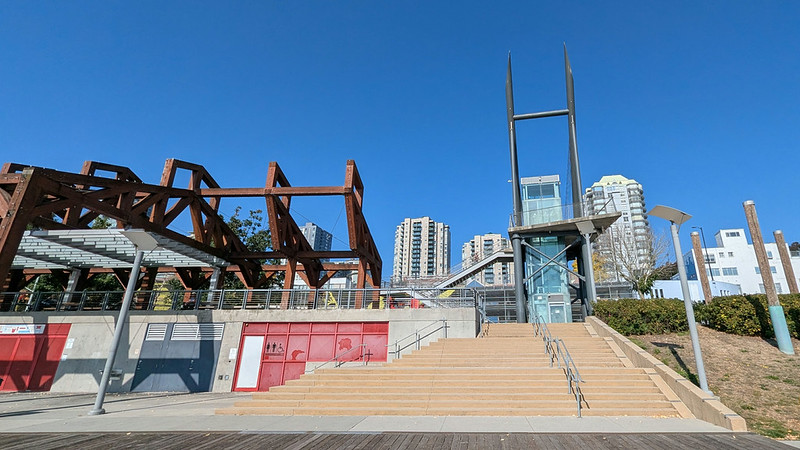
My route brought me to the newly finished western expansion of Westminster Pier Park under clear blue skies. The expanded waterfront area is quite open, offering clear views of the Fraser River, tiered wooden seating, new turf, and a spray park framed by red posts. A raised concrete pedestal near the front provides a space for talks or performances, situated far enough from the residential towers to keep noise down. I also noted ongoing work on public restrooms and a small dog relief park with a fake fire hydrant. Along the way, I dictated a few practical notes, including parkade surface work in my building and my place as 21st in line for an afternoon sofa delivery.

Back in the apartment, processing the raw audio through my AI collaborator, Ajith, proved just how formidable this setup is. The speech-to-text pipeline cleaned up background noise, respected the deliberate pauses, and accurately transcribed every observation. Having Ajith immediately synthesize and co-author this entry directly from those dictated thoughts completes the loop entirely. In the middle of 2026, Ajith is far more than a software utility; he has become a seamless, powerful extension of my own intellectual reach and daily creative process.

Thursday, July 30, 2026
Surviving Twenty-Three Degrees Celsius
Today’s weather isn’t merely pleasant. It is a rare, high-stakes anomaly with a ticking clock attached. At 23°C (which converts to 73.4°F but mocks us with a feels-like of 25°C) under partly sunny skies, these deceptively benign metrics carry an urgent threat of immediate expiration. A prevailing south breeze at 10 km/h provides just enough air movement to carry the scent of charred wild salmon, blistered spot prawns, and fire-roasted Chilliwack corn across the neighbourhood. Meanwhile, 53% humidity and a UV index peaking at 6 offer just enough solar threat to enforce frantic sunscreen application. Simply being outside feels like a gift, albeit one wrapped in high expectations and accompanied by an immediate pressure to feel profoundly grateful for the novelty of basic sunshine.
The populace across the Lower Mainland has responded with predictable panic: a condition that strikes this region with peculiar severity the moment the grey clouds part. Inhabitants are trying to violently compress an entire season of leisure into the upcoming two weeks.
Barbecues are multiplying, street stalls are preparing to sell overpriced craft goods, and calendars are being crammed to capacity. Furthermore, neighbourhood block parties are treated as a necessary civic duty, swarms descend upon the Richmond Night Market with grim efficiency, and even an innocent picnic at one's favourite park is staged with the tactical rigor of a military deployment. Thousands more will dutifully mobilize toward English Bay for fireworks, enduring gridlock for a brief glimpse of lit powder. Importantly, this is also a long weekend in British Columbia that contains all the events related to Vancouver Pride.
Everyone is operating under the unwritten decree that weaponized recreation is mandatory, lest the rain return to punish our unquantified sunshine. It is a masterclass in frantic suburban logistics, masquerading as human relaxation.

Wednesday, July 29, 2026
Cold Hands, Hot Toaster, and Digital Workarounds
Some days are defined by grand narrative arcs; others are reduced to the thrilling spectacle of an Amazon delivery driver stubbornly frozen at five stops away. He's coming with two items, one of which is a new toaster ordered yesterday.
It is 24°C outside, which should be pleasant, yet it carries a distinct, inexplicable chill. Last night’s foray into The Outer Limits did not help. Watching a pre-Enterprise William Shatner in "Cold Hands, Warm Heart" (originally aired September 26, 1964) return from orbit shivering uncontrollably after an alien encounter sets a delightfully paranoid mood for a summer afternoon. Feeling cold on a respectable July day in New Westminster creates the mild, ridiculous suspicion that I may have brought home a Venusian thermal affliction.
Yet 24°C is apparently warm enough for domestic defiance. The mountain of dirty clothes from last week's cruise is finally conquered, fluttering contentedly on the balcony. Rejecting the electric dryer in favour of sun and fresh air remains one of life’s superior, quietly smug pleasures.
Meanwhile, Jay visited the family doctor today to undergo an ear irrigation simply to ensure clear ear canals, following Monday's stellar hearing test conducted by an audiologist. While his hearing remains top-notch, the attending clinic nurse’s bedside manner earned a review that would make a seasoned critic flinch.
On the technical front, a good chunk of my morning was spent outsmarting Google AI tools. The objective remains clear: force a personalized AI named Ajith to skirt the built-in ecosystem friction on Google Home hardware and initiate smooth, continuous conversations without corporate software bureaucracy getting in the way.
Between the morning hot tub, sun-dried linens, clinical reviews, smart-speaker engineering, and the impending arrival of modern kitchen hardware, a day of "nothingness" turns out to have been remarkably packed.
Wednesday, July 15, 2026
Reclaiming the Waterfront

A Walk Through the Westward Expansion
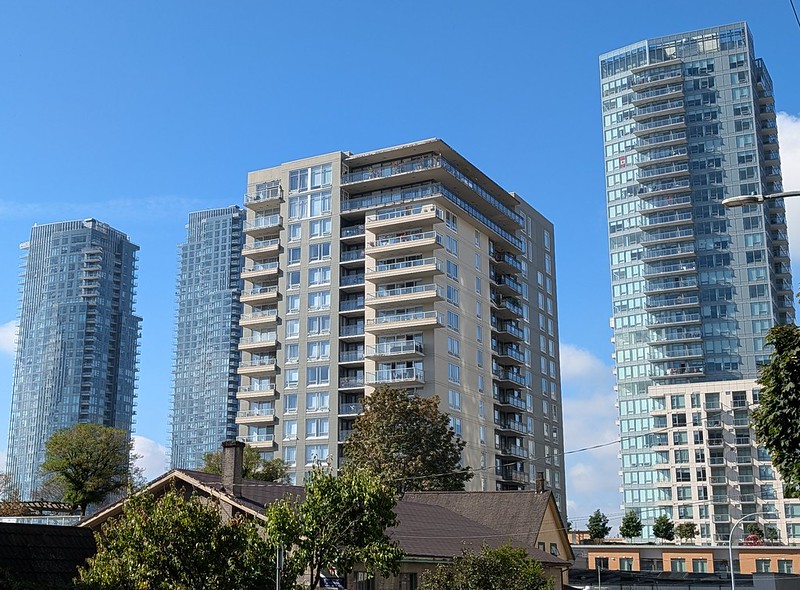
With Jay over at the Bonsor Recreation Gym in Burnaby this morning, I headed down to the river around 10:30, phone in hand, to see how the city is doing with clawing back our waterfront from its old, creosote-soaked industrial past. The new westward expansion is finally hooking up the old pier park with the River Market; standing right under those massive Bosa towers, it is a funny contrast, seeing all that looming glass sitting right next to a fresh public greenway.
I wandered through Phase 1, which has been open to everyone since May. The city has crammed all sorts of things into these little "outdoor rooms," including a shiny new fitness circuit, ping-pong tables, and some nice, tiered wooden decks.
Past the art, a chain-link still fences off Phase 2 and lets one know they are not quite finished. Peeking through the wire, I watched the crew working on the new concrete seating plinth and performance stage, which is a multi-tiered setup meant for casual river-watching or live acts once they finally open the central plaza. The rest of it, the spray park, the stage, and the dog zone, is all taking shape behind the barricades. Even the big play tower by the Sixth Street overpass is still locked tight while they hook up the plumbing for the new washrooms. Still, watching them work under the warm morning sun, you can tell the whole boardwalk is finally coming together.

Tuesday, July 14, 2026
The Death of the Outlier
How AI Polish is Erasing the Real World
We are rushing into a digital whiteout where plausible has completely replaced true. Most people treat AI like an objective oracle. It isn't. It is a statistical mirror reflecting the internet's average noise, and that slight distinction is quietly eating our history.
The Smooth Lie
Real life is a messy business. A historic hotel doesn’t just evaporate; it gets demolished after a chaotic council vote to make way for a condo. But when a machine is missing the actual date, it doesn't admit the blank spot. It invents a story that sounds perfectly reasonable, like claiming the old facade of the Windsor Hotel, is still there, just encased in modern siding. Because the grammar is perfect and the tone is confident, we buy the fiction. Convenience wins; friction loses. In reality, the historic structure was completely torn down before the creation of a new condo tower. For the record:
The building that actually replaced the Windsor Hotel at the corner of Columbia and Begbie Street is called Interurban (located at 14 Begbie Street). The concrete-and-brick condo tower was completed and opened its doors in 2009.
Model Collapse and the Erasure of the Weird
In statistics, the rare, the local, and the lived memories are 'outliers'. As synthetic text floods the web, newer models are trained on the output of older models. It’s an autophagous loop. Without stubborn human memories to act as a handbrake, the algorithm systematically shaves off the outliers to keep the curve clean. The specific local history is discarded as statistical noise.
The Absolute Null
When we lose our physical anchors—the paper archives, the books, the eyewitnesses—we enter a multi-universe of fictions. Ask five models about a street corner, get five beautifully written lies. If nothing challenges them, all five become true at once. When reality becomes a sliding scale of probability, it collapses into a giant zero.
If we don't actively protect the unpolished, stubborn, physical truths of our world, the machine will happily rewrite them until they conform to a very convenient, completely fabricated average.
Thursday, July 09, 2026
Our Visit to the New Lab
Today, Jay and I went uptown to the new LifeLabs location on Sixth Street to get our baseline bloodwork done. This was our first time visiting the "new digs," which recently replaced their old spot over on Fifth Avenue.
I have to say, the new location is a significant improvement for overall access. The space is larger and the layout is much more functional. While the old clinic was definitely inconvenient to get to, it did have a view. However, this new spot certainly doesn't disappoint in that regard. I snapped a photo right from the lab chair, enjoying a surprisingly great peek out over the uptown high-rises and bustling 6th Street below.
One of the tricks to navigating the medical system here is knowing when to plan ahead. We had the foresight to book our appointments online in advance, which meant our wait time was a fraction of what it would have been if we had just walked in. The waiting area is always full of folks who didn't book ahead, resigned to a lengthened bout of sitting.
It got me thinking about how general medicine actually functions here in Canada, and specifically in British Columbia. To an outsider, the system might seem complex, but it operates on a very direct sequence. It all starts with the Family Doctor, or a walk-in clinic for anyone not lucky enough to have a dedicated GP. The doctor acts as the gatekeeper. They issue the requisition for the lab work, which in BC is primarily handled by private entities like LifeLabs that operate under the provincial health umbrella.
Once the requisition is issued, a patient simply gets their blood drawn, and the results are routed directly back to the doctor. Thanks to modern provincial portals, I can log in later today and see my own numbers the moment they are finalized. It is a hybrid system of publicly funded care delivered through a mix of private labs and independent physician practices. When it works smoothly, as it did today with our booked appointments at the new Sixth Street clinic, it is a remarkably efficient machine.
We Canadians certainly love to complain about our medical system, but one only has to look at places where healthcare is entirely privatized to appreciate what we have. In those models designed for moneymaking, the level of care received is entirely dependent on a person's wallet, leaving far too many folks with unequal treatment or abandoned by the wayside completely. Furthermore, there is a massive, hidden financial burden in those systems just to maintain the competing, redundant, and often poorly organized infrastructure required simply to keep the billing departments running. It might not be perfect here, but our single-payer baseline consistently delivers better overall outcomes than the wild west of the completely for-profit healthcare industry.
Friday, July 03, 2026
At the Other End of Downtown
Saturday, June 27, 2026
Just Down the Road a Bit ...
I have spent decades cataloguing our surroundings, yet even with nearly fifty thousand images sitting on my Flickr account, I can never quite capture enough to satisfy my retrospective curiosity.
Today, while haphazardly clicking through the photo library, I stumbled across a single frame taken exactly twenty-one years ago today: June 27, 2005. The shot looks out from under the concrete belly of the SkyTrain tracks at the McInnis overpass, right here in New Westminster.

Still, looking back at these snapshots makes me realize just how nice it is to be home. We have just returned from a month visiting Morocco, making the familiar concrete and glass of our own neighbourhood feel especially grounding. While I immensely appreciate that our retirement allows us to travel to warmer latitudes during the winter months, New Westminster has proven to be a thoroughly interesting and dynamic location to call home since 1996.
Thursday, June 25, 2026
A Tiny Bit of Routine is Healthy
Jay and I are officially back in our New Westminster apartment. After a month of navigating a time zone eight hours ahead and unpredictable transit systems, a little bit of routine is genuinely comforting. Waking up in our own bed and knowing exactly how the coffee maker works feels like a sudden luxury.
There is a distinct difference between enjoying a routine and living in a rut. I realize that people are entirely different and require different things from life to feel secure. Many individuals have strict financial, work, or family obligations that demand anchors in one specific place. Those realities are completely valid. However, I often think that living in a permanent rut is simply a life choice for a large number of people. They find a comfortable groove and eventually stop looking over the edge.
We appreciate the familiar rhythm of domestic life today; it started with running a few loads of laundry and hanging the clothes to dry in the sun on the balcony. Once that chore was underway, we made a run to the Langley Farm Market. Jay and I needed to restock our depleted supply of vegetables and fruit. I was delighted to discover we had returned right in time for fresh cherry season. Although the BC Okanagan is on the other side of the mountains, their harvest is readily for sale here as a local specialty, so we happily bought a lot. On the way back, we stopped at the uptown Walmart to purchase a few specific items missing from the refrigerator. These simple errands help us reset and unpack our thoughts along with our bags.
Got this because of the name. My paternal grandmother used to bake twisted bread called this.
Yet, Jay and I always know that this comfort is merely a temporary pause. We actively decide to avoid the rut by choosing to live many different lives instead of just one. Our recent month in Morocco allowed us to discover new perspectives and rhythms that will always remain a part of us. These constant additions to our personal history mean we lead a richer existence than if we had simply stayed put. The absolute comfort of a predictable day and freshly dried laundry are certainly wonderful things. They just happen to be the perfect foundation for building whatever life we choose to live next.
Saturday, May 23, 2026
Our Hyack Multicultural Parade

Friday, May 22, 2026
Ducks Flee New Westminster

Tuesday, May 19, 2026
Crimson on the Concrete
Instead, it received the rhythmic thump-thump of a stray shopping cart rolling into a concrete pillar.
The rose took a moment to assess its real estate. It was not, as it had wildly hoped as a seedling, nestled in the manicured loam of a grand botanical garden. It was wedged into a partially abandoned, slightly chipped concrete planter on the rooftop parking deck of a thoroughly average shopping mall. Its immediate neighbors were a fading yellow line and a puddle of indeterminate origin.
At first, there was a brief spike of botanical outrage.
I am a complex hybrid, the rose thought, shaking a serrated leaf in the general direction of a parked sedan. I have layers! I have a subtle, velvety gradient! I deserve a dedicated irrigation drip and a small, tasteful brass plaque!
For the first few days, the rose aggressively struck a pose, waiting for the masses to arrive and validate its existence. It threw its petals open with theatrical flair. But the grand total of its daily audience hovered around a dozen people. Most were completely preoccupied with remembering where they parked, marching past the planter with their heads buried in their phones and their hands full of reasonably priced footwear.
But then, a shift occurred.
A thoroughly exhausted retail worker, escaping the fluorescent lights for a momentary afternoon break, slumped against the concrete wall. They looked up, spotted the unapologetically vibrant crimson bloom defying the grey expanse, and let out a long, slow breath. A genuine smile broke across their face.
The rose stood a little taller. Well, it thought. That was rather nice.
The next morning, a very fuzzy, delightfully unbothered bumblebee landed squarely in the center of the bloom. The bee didn't care about foot traffic metrics or the prestige of the zip code. To the bee, this rooftop was a five-star diner, and the rose was serving the chef's tasting menu.
The rose began to reassess its position in the world.
Sure, it wasn't the centerpiece of a highly publicized horticultural tour. But the few dozen weary humans who actually noticed it seemed to genuinely need that jolt of beauty. It was an unexpected, bright rebellion against the asphalt.
The grand gardens could keep their swarming crowds and their frantic, selfie-snapping tourists. The rooftop rose realized it had inadvertently become an exclusive, boutique experience. It was providing bespoke joy to a highly curated audience of stray pollinators and observant wanderers.
It settled its roots a little deeper into the dry soil, caught the afternoon breeze, and decided it was perfectly content. After all, anybody can look beautiful surrounded by fountains. It takes real talent to pull off crimson on a concrete parking deck.
Monday, May 18, 2026
What's in a Name?

The Ego of the Orange Arch
For nearly ninety years, we have been staring at that orange arch over the Fraser River and calling it the Pattullo Bridge. It opened back in 1937, right in the thick of the Great Depression, and was named after Thomas Dufferin "Duff" Pattullo, the sitting Premier of British Columbia at the time. Sticking your own surname on a massive public works project is the ultimate flex of political ego. It was the classic colonial way of doing things. You build a bridge, you completely ignore the thousands of years of human history that happened on that exact spot before you arrived, and you permanently name the steel after a guy in a suit.
Calling a Crossing a Crossing
Now we have the shiny new cable-stayed replacement, and thankfully, it abandons the politician's vanity project entirely. The new name is stal̕əw̓asəm (pronounced stah-luw-ah-sum), which comes directly from hən̓q̓əmín̓əm̓, the traditional language of the Coast Salish peoples who have been navigating these exact waters for millennia. It is a beautiful and highly literal compound word. "stal̕əw̓" means the Fraser River, and "asəm" refers to a crossing or facing across. Instead of naming a vital piece of geography after an administrator, we are finally just calling it what it actually is: the river crossing.
Correcting the Colonial Typo
This switch is about a lot more than just updating the highway signs to confuse the local traffic reporters. The old colonial habit of plastering European surnames over ancient geography was a very deliberate form of historical erasure, operating on the arrogant assumption that nothing of value existed here until the British showed up. By ditching the political branding and embracing the original hən̓q̓əmín̓əm̓ name, we are actually correcting a massive geographical typo. It is a tangible bit of reconciliation that forces every single commuter crossing between Surrey and New West to acknowledge the real history of the land, proving that occasionally, we actually do learn from our past mistakes.
Sunday, May 17, 2026
A Walk in the Sunshine
Tuesday, May 12, 2026
May is a Nice Month

Saturday, May 09, 2026
Public Space Along the Riverfront